ur local hookr
Sweet Mourning Lamb - Babydoll Dress
Sweet Mourning Lamb - Babydoll Dress
Couldn't load pickup availability
About This Item
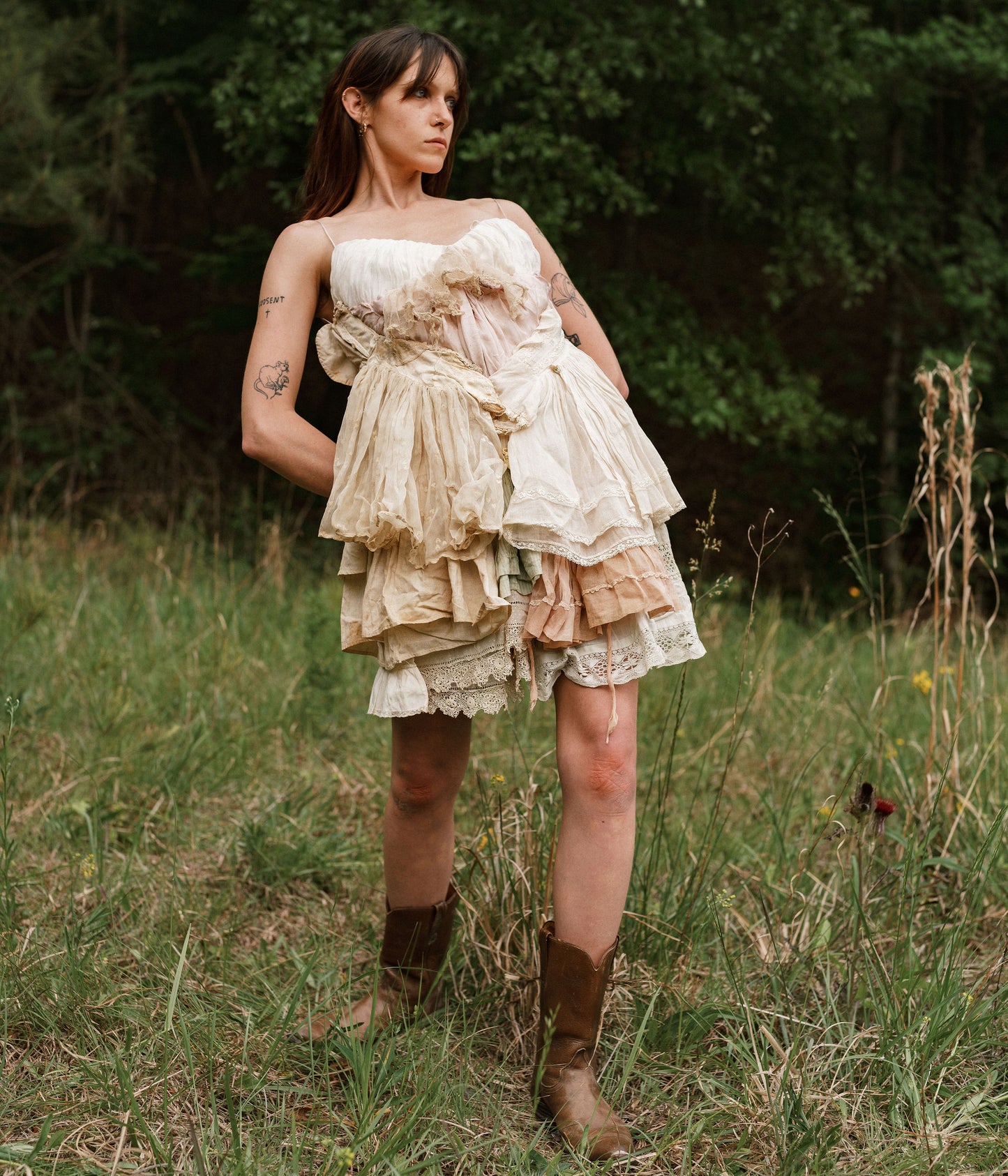
This dress is made entirely from antique babydoll clothes, ranging from handmade petticoats to Madame Alexander gowns. Each dress is hand-sewn to the garment in a way that showcases the delicate details of the individual dresses while layering them upon one another to create a billowing, ballerina-like silhouette. The materials range from gauzy tulle to lacework to cotton, beautifully contrasting and complimenting one another. To reduce both the wearer’s discomfort and the likelihood of snagging the delicate materials, the inner-most layer of this piece is a satin slip, labeled a size XL/US10.
About the Process
This dress is made of antique doll dresses, all varied in size, material, and state of decay. I found these dresses in Hueytown, Alabama, at the estate sale of a woman whose adoration for feminine dolls must have been immense. She had boxes and boxes of dolls, doll dresses, doll ephemera, doll shoes, doll books, etc. While most of the ones in good repair seemed ready for new homes, I found a box of the less desirable pieces, rust-stained clothes, and otherwise mismatched contents. That was the box of items that would become this dress.
While hand sewing, I alternated between blanket stitches (for dresses sewn closer to the slip), needle turn stitches (for outer layers and anything visible), and running stitches (to baste things in place and lend extra strength). Because of this attention to detail, there should be little to no visible seams on this garment without close inspection.
The ashy-pink bodice of this dress is achieved using cartridge pleats, stitched loosely. It was very important to me that the doll dresses not be pressed or altered in any way that wasn’t necessary, both to preserve their decaying charm as well as to reduce the chances of causing the fibers any further damage. That said, the bodice piece is the only one that I applied any steam to, as I wanted the pleats to relax just a bit, rather than bunching up. The goal for this part of the dress was to look folded and layered—almost vaginal. Since this part of the dress is so central, it seemed like the obvious place to enforce some symmetry. Due to the chaotic nature of the materials, asymmetry rules over most of the dress, so pulling the eye to a balanced center grounds the chaos somewhat, assuring viewers of purpose. I pinned and re-pinned this portion until it felt right, then added the structural stitches.
In its entirety, the construction of this dress took over 100 hours of hand sewing, not including the time spent arranging and rearranging the doll dresses into the larger shape. While I did not deplete my supply of doll-related materials, I used 15/17 doll dresses in this project (the last two were bright red and thematically felt different from the rest).
Meaning
In exploring themes of femininity through innocence, (e.g. the sacrificial lamb), the investigation leads to a consistently inevitable loss of innocence. As discussed in the description of my art piece, Held, women often have an unfortunately passive role in western culture. In the same way that women’s sexuality is almost exclusively discussed in the passive voice, the “loss of innocence” idea mirrors that same passivity, never placing blame on an active force that commits the theft of that innocence. The innocence was lost, but who took it? By never identifying the active participant, women are left to feel as if there is something faulty within themselves. At most, they might be pitied, but if the loss of their innocence is inevitable, then there is no justice to be had. In the song, Ptolemea, by Ethel Cain, a male voice declares, “I am no good nor evil, simply I am / And I have come to take what is mine / I was there in the dark when you spilled your first blood / I am here now, as you run from me still”.
These sweet baby doll dresses, stained with rust, torn, and brittle with rot, communicate a desperation for acceptance and love despite their flaws. The dresses did nothing themselves to earn their tattered fragility, so are they less beautiful now because of the violence acted upon them, even if that violence was simply existing in a world of brutal elements?
In Ptolemea, this idea is climactically captured in the brutalization, abuse, and murder of a girl at the hands of Isaiah, a man who claimed to love her. “You poor thing / Sweet, mourning lamb / there is nothing you can do / it’s already been done” Isaiah says, assuaging all hope that any escape is possible from an inevitable end. Ethel Cain, the titular character, has lost her innocence in every conceivable way. Ethel’s earthly experience ends as Isaiah consumes her corpse. This is the final way that her feminine body might be taken, used, and acted upon. Even in death, she may not rest.
This is the idea that drove me in creating this collection of art, and especially in creating this dress. Even imagining the woman who collected all of these delicate babydoll dresses, keeping them close to her until she died, underscores this idea that we, as women, must hold on to whatever softness and innocence we can find because we all know, in the end, the loss is coming.
“run then, child / you can’t hide from me forever.”
Note:
this dress is priced absurdly high because I do not want anyone To purchase it without deep contemplation. This is an art piece constructed thoughtfully over a long period of time. The listed price is not necessarily what this item is worth, or what I expect to sell it for. If you are seriously interested in purchasing this item, please reach out to me through email at urlocalhookr@gmail.com or send me a message on Instagram @urlocalhookr. If you’re interested in using this dress for another purpose, such as photography, modeling, or any other reason, I’d also love to discuss what that would look like as a loan or rental.
Share